
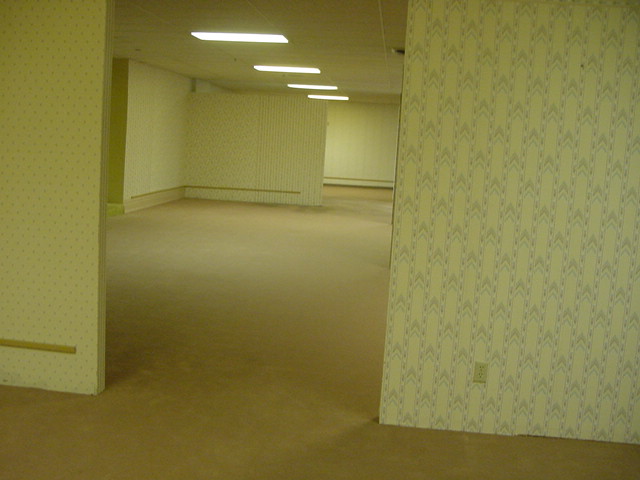
For years, gamers have wandered the endless yellow hallways of Backrooms games asking important questions.
“Where am I?”
“Why is everything carpeted?”
“Who keeps paying the electricity bill?”
But nobody has dared ask the most controversial question of all:
What if the Backrooms are racist?
After approximately six minutes of research and seventeen hours of arguing on social media, we have reached a conclusion: the evidence is deeply concerning.
The Beige Supremacy Problem
Let’s start with the obvious.
The Backrooms are yellow.
The walls are yellow.
The lights are yellow.
The carpet is yellow.
The atmosphere is yellow.
At what point does a color scheme stop being an artistic choice and start becoming a manifesto?
Gamers have spent years fleeing horrifying entities, yet nobody has questioned why the environment itself seems committed to a single-color political agenda.
Coincidence?
Probably.
But that’s not going to stop us from writing 1,200 words about it.
The Diversity Crisis
Take a moment to look around the average Backrooms map.
What do you see?
Hallways.
More hallways.
An occasional room.
Additional hallways.
You know what you don’t see?
Representation.
Not a single coffee shop.
No libraries.
No bowling alleys.
No municipal zoning diversity whatsoever.
The Backrooms claim to be infinite, yet somehow they exhibit the urban planning philosophy of a corporation that discovered copy-and-paste.
The Entity Hiring Practices
Let’s talk about the monsters.
Most Backrooms games feature entities whose primary qualifications appear to be:
- Screaming
- Running at people
- Existing in low-resolution environments
Has anyone reviewed their hiring process?
Where are the employee benefits?
Where is the anti-discrimination training?
Why are all performance evaluations apparently based exclusively on “ability to chase player”?
These questions remain unanswered.
The Introvert Erasure
The average Backrooms game assumes that every creature wants to hunt you.
This is an outrageous stereotype.
What about monsters who just want to read books?
What about entities pursuing higher education?
What about the creature that sees the player and immediately says, “Sorry, I’m not really a people person”?
The genre has systematically ignored these voices.
The Infinite Hallway Privilege
Backrooms enthusiasts frequently argue that infinite corridors are essential to the experience.
That’s easy to say when you’re a hallway.
Have we considered how the rooms feel?
Every discussion centers on corridors.
Every screenshot features corridors.
Every YouTube thumbnail showcases corridors.
Meanwhile, rooms are expected to sit quietly and be grateful for occasional recognition.
Frankly, the architectural bias is impossible to ignore.
The Fluorescent Lighting Question
Researchers have identified a disturbing trend.
The lights never stop buzzing.
Ever.
This creates an environment hostile to literally everyone.
Inclusion means accommodating different needs, and that includes people who would prefer not to feel like they’re trapped inside an aggressively illuminated office building from 1997.
The Verdict
After careful consideration, we have determined that Backrooms games are not actually racist.
However, they are guilty of:
- Excessive hallway dependency
- Reckless use of fluorescent lighting
- Crimes against interior design
- First-degree carpet possession
- Aggravated beige
Despite these shortcomings, the genre continues to deliver memorable horror experiences, existential dread, and enough buzzing noises to permanently alter your relationship with commercial real estate.
In the end, perhaps the true monster wasn’t racism.
Perhaps it was the carpet we walked on along the way.
Final Rating: 8/10
“It really makes you feel like a guy trapped in an abandoned office.”

Leave a Reply