
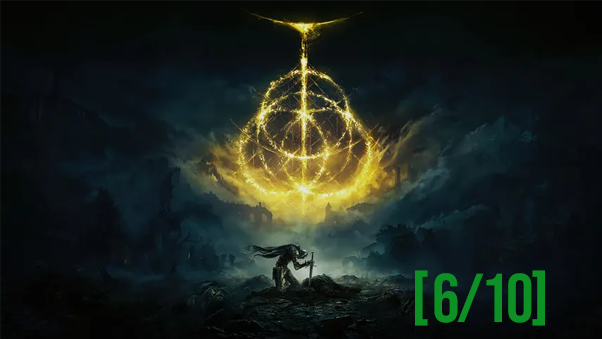
Elden Ring has been celebrated as a masterpiece, but beneath the overwhelming praise lies a game that struggles to escape the shadow of Dark Souls. While FromSoftware’s latest expands the formula into an open world, it rarely evolves it in meaningful ways. Instead, Elden Ring often feels like an oversized collection of familiar mechanics stretched across a map that mistakes scale for depth.
The similarities to Dark Souls are impossible to ignore. Nearly every core system has been lifted directly from FromSoftware’s earlier games: the stamina-based combat, corpse runs after death, cryptic storytelling, dodge-roll-heavy encounters, and obscure questlines that practically require outside guides to follow. Even many enemy designs, animations, and dungeon concepts feel recycled. After dozens of hours, the sense of discovery begins to fade, replaced by the realization that Elden Ring is less a bold new experience and more a repackaged greatest-hits compilation.
The open world itself is visually striking at first, but it quickly exposes its weaknesses. Huge portions of the map are filled with repetitive caves, recycled bosses, and copy-pasted encounters that artificially inflate playtime. Players are constantly rewarded with crafting materials or minor loot that rarely feels meaningful. Exploration starts as exciting curiosity but eventually becomes exhausting busywork.
Combat also suffers from the same frustrations longtime critics have pointed out in FromSoftware games for years. Enemy attacks are deliberately delayed to bait dodge timing, bosses chain together endless combos, and difficulty often feels designed around trial-and-error memorization rather than skillful adaptation. Instead of rewarding creativity, many encounters push players toward exploiting overpowered builds or summoning assistance just to bypass frustration.
And despite the praise for immersion, Elden Ring is far from realistic. The world operates almost entirely on videogame logic. Massive enemies appear without explanation, characters speak in cryptic riddles instead of believable dialogue, and physics are routinely ignored whenever spectacle demands it. Giant swords swing like plastic props, impossible creatures casually survive fatal injuries, and the game prioritizes dramatic imagery over coherent world-building. For players seeking a grounded fantasy experience, Elden Ring can feel emotionally distant and artificial.
The storytelling doesn’t help. Like previous FromSoftware titles, the narrative is buried beneath vague item descriptions and fragmented lore. Some players enjoy piecing together theories online, but others will simply find the story underdeveloped and unnecessarily obscure. Important characters vanish without resolution, motivations are barely explained, and the emotional stakes rarely land because the game refuses to communicate clearly.
There’s still enjoyment to be found here. The art direction is impressive, the soundtrack is powerful, and moments of exploration can create genuine awe. But those highs are buried inside a bloated experience that relies heavily on recycled ideas and punishing design philosophies that increasingly feel outdated rather than innovative.
For all its ambition, Elden Ring ultimately proves that making Dark Souls bigger doesn’t necessarily make it better.
Score: 6/10

Leave a Reply